
Siracusa is a woman
- 3:00 h
- 1,6 KM
- Easy
The beautiful Siracusa è Fimmina (is a woman), is a woman deep in its soul and in the heart of the city.
It is shown by the numerous feminine stories and myths that enrich the history of the evolution of this city. Here is a tour to know the feminine myths and legends of the heart of Siracusa, this means the isle of Ortigia.
From the Apollo’s temple to Diana Fountain, going through the cathedral, soon after piazza Minerca and Fonte Aretusa, the sound of the women’s voices of Siraucsa will be loud and clear. Siracusa is woman since its foundation. A charming version of the historian Genesio assigns the foundation to Syra and Koss, the daughters of Archia.
Discover how to meet the women of Siracusa. Start at Apollo’s temple, where you will know the myth of Apollo and Dafne: when Eros revenge from mokery made by Apollo. Continue on piazza Archimede to admire the fountain devoted to Diana, huntress and virgin goddes, and go on up to piazza Minerva – where Artemide killed her beloved – and reach then the temple dedicated to Athena, goddes of wisdom who protects Siracusa. Finish your tour in the place where the nymph Aretusa turned into a fountain and at the Marina of Siracusa to remember “the miracle” of St. Lucia (patron Saint of Siracusa).
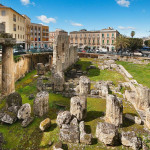
Apollo’s temple
It is the oldest Doric stone temple in Sicily. Dating back to the sixth century BC., it underwent various transformations starting from the Byzantine period. It was first turned into a Christian basilica, then into a mosque by the Arabs and again in a Christian …
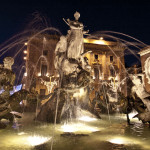
Archimede square
At the center of the square stands the beautiful fountain of Diana of the sculptor Giulio Moschetti of 1906 which tells the legend of Arethusa. The nymph is portrayed in the act of fleeing from Alpheus who, with his outstretched arms, tries to grab her. …

Ionic temple
Found in the basement of the Palace of the Senate, the Ionic Temple or Artemision, dated to the late sixth century BC., is where the deepest roots of ancient Syracuse are. Located in parallel to the Athenaion (now Cathedral) it delimits an area of great …
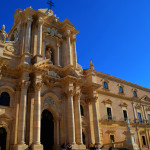
Cathedral of Siracusa
The Doric temple was built in the fifth century BC. by the tyrant Gelone following the victory against the Carthaginians in the battle of Imera. The Athenaion was hexastyle (six columns in front), periptero (columns surrounded the cell on all four sides), with 14 columns …
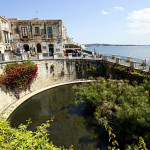
Fonte Aretusa
The legend tells that river god Alpheus fell in love with Arethusa, nymph of Artemis, and he tried to seduce her in every way. Aretusa invoked the intervention of the goddess that turned her into a spring. Sank beneath the Ionian, Aretusa was to lead …

Forum Vittorio Emanuele
Forum Vittorio Emanuele II, with its trees and benches, is the perfect place for a quiet walk. From here you can admire the port and part of the old city. Walking along the Forum, built to celebrate the unification of Italy, one encounters the Porta …