
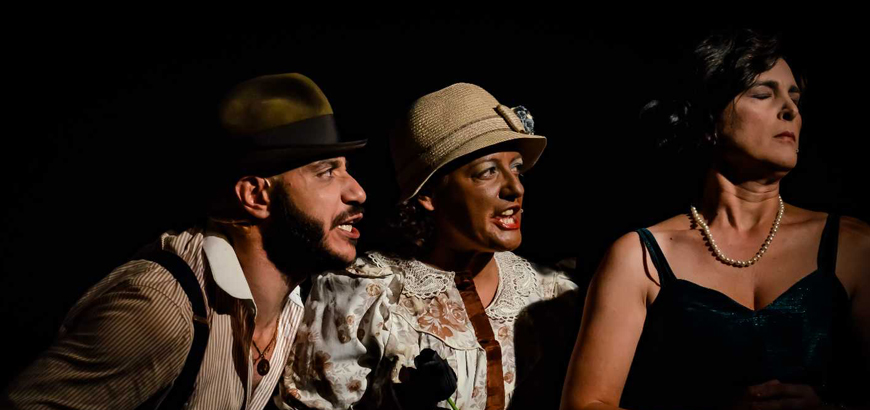
Ippolito at the Benedictine Monastery

On 17 July 2019
Euripides’ tragedy of extreme passions
Fedra’s passion, which is a fever of high love, with no chance of recovery; the passion of Ippolito which is fanaticism and exaltation of all that is pure and chaste (and therefore first of all exaltation for itself); the passion of Theseus, which is fatal and destructive wrath in which grace finds no abode.
All three protagonists of this tragedy verbalize their passions obsessively.
They are three showy, showy characters, whose words have the ability to analyze, hide, change, camouflage, expand the events of the tragedy. Extreme characters, therefore, with a great soul.
The actors as in a game of calls and evocations will face all nine characters of the Euripides tragedy. The transformations will all be scenic and visible, so that each character can be revealed in its closest correspondent in the most direct and obvious way.
The tragedy is set in late 1950s America, Eisenhower’s America, bigoted and omertosa, racist and male chauvinist. An America that, beyond everything, begins to realize its backwardness and that it will welcome the inexorable cultural and political revolution promoted by Kennedy.
Such a historical context reflects well and in depth the spirit and strength of the characters of the tragedy of Euripides in continuous conflict between immobility and movement, between religious bigotry and libertarianism, between body and inner work.