
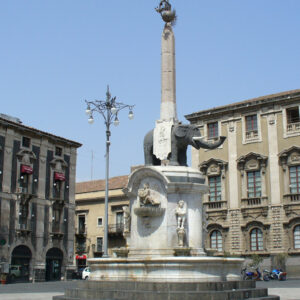
Elephant’s fountain
The Elephant’s fountain or even “Liotru’s fountain” was built by Gianbattista Vaccarini in 1757. In the basement there are some carved cherubs and two bas-reliefs representing the city’s two rivers, the Simeto and the Amenano. For people of Catania it is ‘u Liotru’. … read more

Saint Giuliano’s Church
It’s located in the charming and characteristic via Crociferi, it’s seen by many as the “pearl” of the eighteenth century city’s reconstruction. Although this building is attributed to Vaccarini’skill and was probably built between 1739 and 1751. … read more
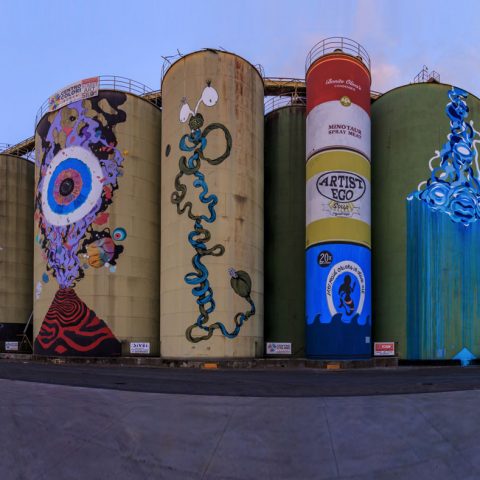
Street Art Silos
The city port has undergone a transformation and become an open air art installation. Eight silos became a spectacular 21st century monument; not mere graphic representations but a contemporary story that is inspired by Sicilian traditions. … read more

Church of St. Maria del Suffragio
The church of St. Maria del Suffragio stands in the district called “Quartiere dei Morti”. The church, built in the first half of the Seventeenth century, was restored after the earthquake of 1693. … read more

San Pietro Clarenza
The commune of San Pietro Clarenza (6,000 inhabitants) is situated on a hill at an altitude of 463 m.s.l. on the southern side of Etna. Its origins date back to the … read more
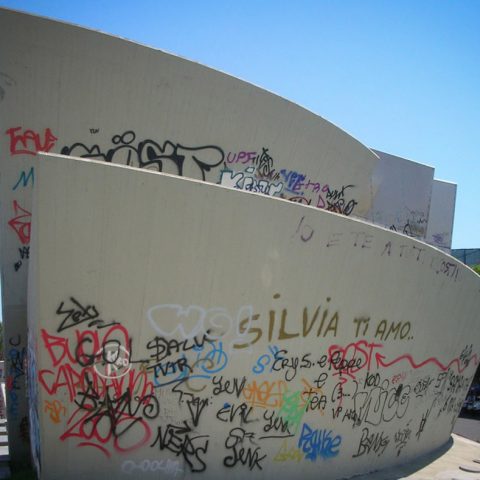
Monumento ai Caduti
A place overlooking the sea and one of the many symbols of Catania that aims at urban regeneration: Monumenti dei Caduti of Catania is a stone’s throw from the village of San Giovanni Li Cuti. … read more

Arvulu Rossu Tree
A symbol of extreme importance that unites past, present and future in an unbreakable thread. First stop on the Catania Rainbow, a highly symbolic place linked to the memory of the forty-five “Iarrusi.” … read more
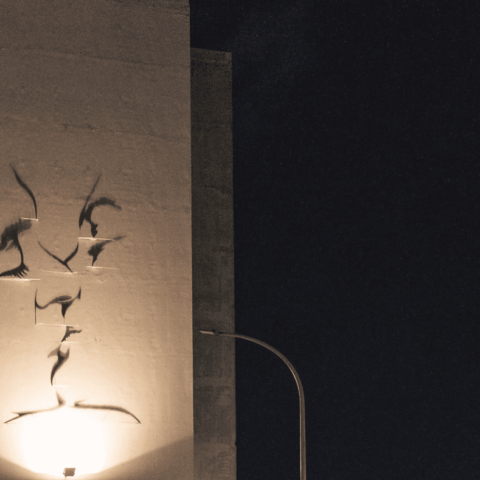
La Sognatrice and Amare
In the vibrant heart of the Librino district in Catania, art becomes a beacon of hope and renewal. Through the murals by Fabrizio Corneli, the anonymous facades of the buildings are transformed into living canvases. … read more

Park of Monte Ceraulo
In Mascalucia you can find a wonderful example of typical Mediterranean vegetation. The Park of Monte Ceraulo born from the overlapping of lava flows. Its flora witnesses the richness and variety of the magnificent Etna’ wood. … read more
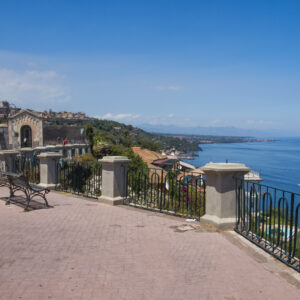
Village of Santa Caterina
The village of Santa Caterina, formerly known as “Cavallari”, is made up of narrow streets decorated with flowers and citrus trees. The village is located on one of the highest lava ridges of Timpa; an impressive view enriched by the precipice on the sea. … read more
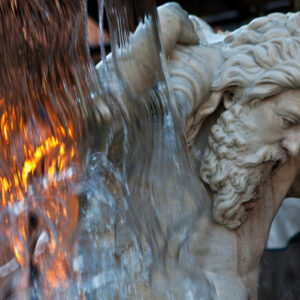
Amenano’s fountain
In front of the Elephants’ Palace, the Town Hall, on the south side of Piazza Duomo you can see the Amenano’s fountain, its name derives from the Amenano river that flows underground. People of Catania call this marble fountain: ‘acqua o’ linzolu’. … read more

San Gaetano alle grotte Church
The church of “San Gaetano alle grotte” is located in Piazza Carlo Alberto, near the church best known as “del Carmelo”, where it is organized the traditional “a’ fera o luni”. The church stands on the ruins of a religious building dating back to 261 AD. … read more
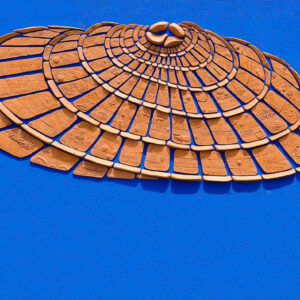
Porta della Bellezza (The Gate of Beauty)
The Gate of Beauty in Librino district is a monumental sculpture in terracotta, the largest terracotta work in the world. Sign of welcoming and hospitality, the project belongs to Antonio Presti and includes the artworks of several Italians sculptors sharing the subject “The Great Mother”. … read more
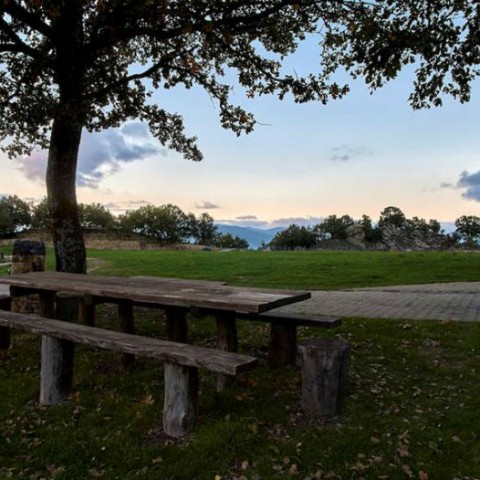
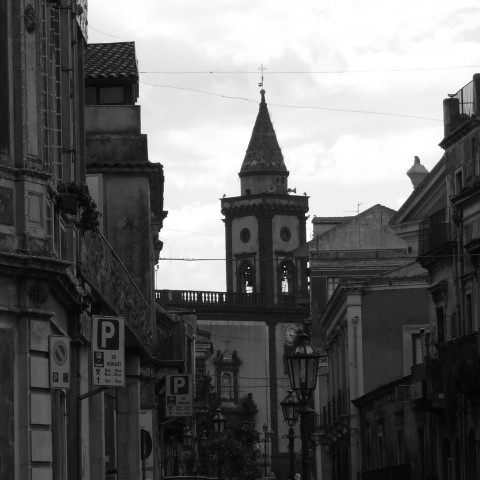
Mascalucia
A large town to the north-east of Catania that lies along the main route up to Etna, on hills that form the southern slopes of the volcano, betweeen 420 and 520 m.s.l. It was inhabited until Roman times; today the he old town centre of Mascalucia is centred on via Etnea. … read more

Ex Rimessa AMT
A new “AMT ART PROJECT” project, thanks to which spaces can be filled, through initiatives to create new places of art and urban aggregation. … read more


L’Etna Osservatorio Astrofisico
The Etna Astrophysical Observatory offers spectacular views for stargazing and guided astronomical tourism in Sicily.

Piazza Università
It’s located not far from Piazza Duomo, along the via Etnea, Piazza Università takes its name from the Siculorum Gymnasium also known as Palazzo Università. The characteristic of this square are the four bronze lamps positioned at its four corners depicting characters of folk tales from Catania. … read more

Sanctuary of the Madonna of the Sciara Mompileri
In 1537 and in 1669 two lava flows, born as a result of the eruptions of Etna, hit the ancient sanctuary full of sacred works. For years, people dug without any success until 1704, when it was found the stature of Madonna delle Grazie. From then, near to it there is a small church. … read more