
The Secret Paths of Catania: Discovering the Architectural and Necropolises of the Roman
Citymap SiciliaArticle writed in collaboration with the team of the print and online magazine Living in the City, an initiative born in Catania with the goal of highlighting local stories and culture.
Underground Catania: Archaeological Finds from Ancient Rome
Imagine walking through the historic center of Catania, among the bustling streets and crowded squares, unaware that beneath you stretches an underground world rich with archaeological wonders. The city, like an ancient manuscript of overlapping civilizations, holds centuries of history, including the old Roman Catania, just waiting to be uncovered.
Yet, often what remains of this past is hidden from the eyes of its citizens, buried under layers of asphalt and concrete. In the frenzy of modern life, the richness of our historical heritage often escapes us. However, thanks to archaeological excavations and research, we have the opportunity to step back in time and immerse ourselves in old Roman Catania.
Through this journey, we will lead you to discover some of Catania’s lost excavations, with a special focus on the Catania’s cultural heritage, which risks being forgotten.
Where find the archeological remains
The few architectural remains from the Roman era in Catania are mainly concentrated around the Forum, located in the Cortile San Pantaleone. The thermal complexes of Via della Rotonda and Piazza Dante, as well as the Ancient Theatre and the Odeon along Via Vittorio Emanuele, are silent witnesses to ancient theatrical performances, transporting us back in time to unveil the treasures of the ancient city.
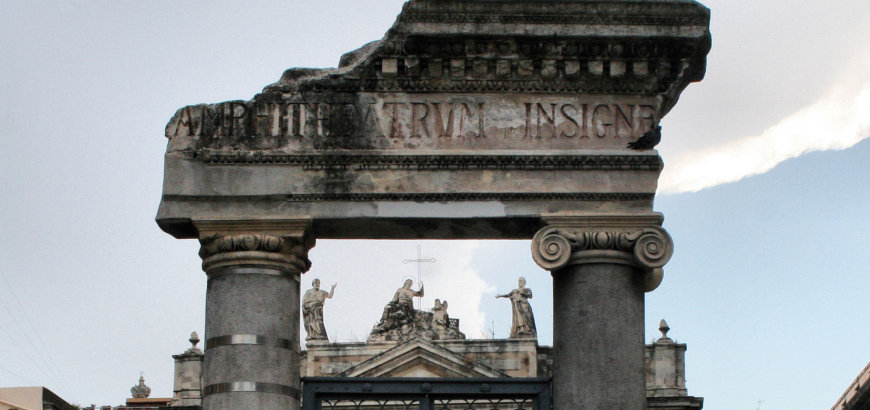
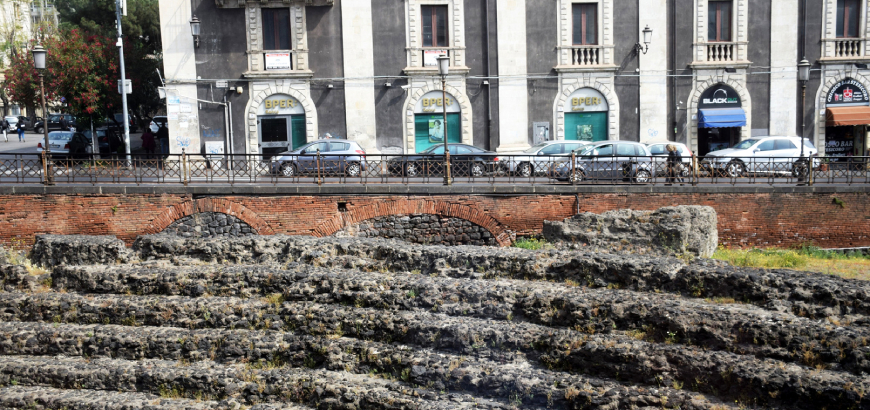
To the north and east of the Amphitheater in Piazza Stesicoro, Roman necropolises were spread out, where families buried their deceased with rites and honors. Today, fragments of this history can be found at various points throughout the city. Archaeological remains lie beneath La Rinascente and the post office building on Via Etnea, as well as on Via Ipogeo, Via Sant’Euplio, and Piazza Santa Maria di Gesù.
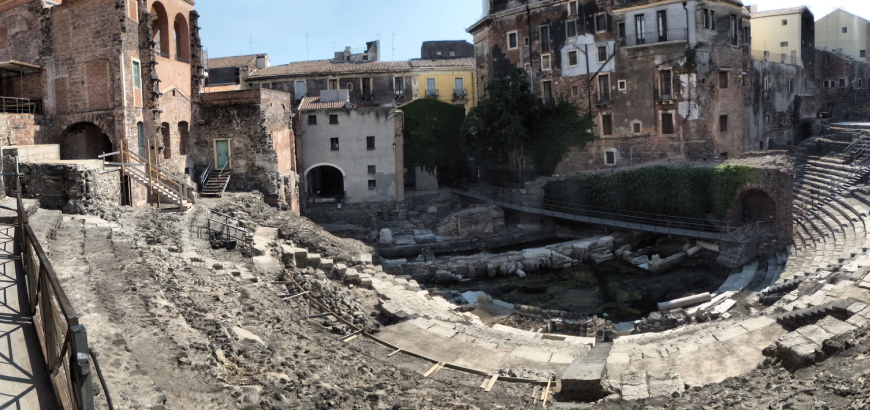
János Korom Dr. https://www.flickr.com/photos/korom/
Discover together some of the Roman Necropolises found in the underground of Catania.
Roman necropolises in Catania extend in several areas.
Among the most significant sites is the area around Piazza Santa Maria di Gesù and Viale Regina Margherita, where important archaeological finds have been discovered. The Church of San Euplio houses an underground chamber, presumably used as a tomb during the Roman era, featuring wall paintings and traces of frescoes that testify to the ancient function of the site. The private garden of Villa Modica, located on Viale Regina Margherita, hosts a circular Roman Mausoleum with a diameter of about 8 meters and an arched entrance. This mausoleum, along with other finds in the area, confirms that the area around Piazza Santa Maria di Gesù was a Roman funeral site.
The Church of San Gaetano alle Grotte, located at Piazza Stesicoro, is built on the remains of an ancient Roman temple and preserves a Roman hypogeum cistern later adapted as a paleo-Christian tomb. The Roman Hypogeum of Catania, located near the Modica Mausoleum, is a circular plan tomb from the Imperial Roman era, about 15 meters long. It features niches for cinerary urns and a narrow corridor leading to a loculus. In Via Gaetano Sanfilippo, a Roman construction can be found inside the private courtyard of a modern building. It is a small Roman funerary chamber that attests to the presence of ancient monuments even in contemporary urban contexts.
The Caserma Centro Documentale Esercito of Catania houses the Roman Mausoleum of Carmine, a funerary building from the Roman era dating back to the 2nd century. Finally, the Chiesetta della Mecca, located inside the Garibaldi hospital, is actually an ancient Roman columbarium with 18 loculi arranged along its walls, evidence of a widespread funeral practice in ancient Rome.
The city of Catania, thanks to its excavations, offers its citizens and tourists a unique opportunity to discover its millennial history and the secrets hidden under the streets trafficked every day. From thermal complexes to necropolises, from theaters to hypogea, each discovery tells a part of the rich history of the city.
If you are a lover of discovering past civilizations and wish to immerse yourself in stories buried over time, or are looking for a unique experience while in Catania, you should treat yourself to a visit to the Roman necropolises and the architectural remains of the Roman era hidden under the city streets.
To visit the Hypogeum and the Monumental Complex of the Rotonda, entry is free, but by reservation.
Contacts: poloregionalect.urp@regione.sicilia.it – 095 7150508.
To visit the Chiesetta della Mecca and the Church of Sant’Euplio, you can book a visit through the Etna’ngeniousa association.
Contacts: 338 1441760 – asso.etnangeniousa@gmail.com.