
Vaccarini and the Catania baroque style
- 3:00 h
- 2 KM
- Easy
After the devastating earthquake of 1693 and the fury of Etna, Catania was faced with the need to reinvent itself. Leading this revival was Giovan Battista Vaccarini, who was called in 1730 to serve as Superintendent of the University Building and Architect of the Cathedral. His work was not only a work of reconstruction, but a real urban project, capable of restoring to the city a unitary, monumental and unique face in its style.
Vaccarini redesigned squares and road axes with a scenographic eye, inserted civil buildings and churches that combine rigor and magnificence, monumentality and plastic grace. Its architecture creates urban scenography: facades that look like theatrical backdrops, perspectives that guide the gaze, domes and bell towers that dialogue with the urban landscape.
Follow the route proposed by Citymap Sicilia to admire its most representative works: you will be able to immerse yourself in a baroque Catania that surprises with harmony and theatricality: from the solemnity of the Cathedral and the symbolic strength of the Elephant Fountain, to the refined elegance of the Abbey of Sant’Agata, up to the façade with pyramidal ashlar pilasters of the Benedictine Monastery. Each stage tells not only the flair of a great architect, but also the ability of the city of Catania to be reborn through the beauty of the Baroque style.
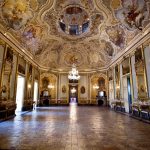
Palazzo Biscari
Along via Dusmet, not far from the “Pescheria”, it’s located the Palazzo Biscari, which takes its name from the Biscari principles who lived there. The palace has several rooms in rococo style, full of frescoes and decorations. Today its museum hosts MF “Museum&Fashion”.
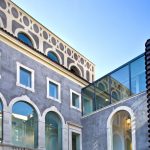
Palazzo Valle
The Palazzo Valle is perhaps the most beautiful baroque buildings designed by the famous architect Gianbattista Vaccarini. From 2004, Fondazione Puglisi Cosentino is in the inner courtyard, at the second and third floor of the baroque palace, hosting permanent and temporary exhibitions.

Saint Agatha’s Cathedral (Duomo)
Saint Agatha’s Cathedral takes its name from the “Santuzza” protector of the city, her feast day is on February 5th. With its massive structure, the Cathedral has the characteristic contrast between the gray and white marble it’s used for the decorations.
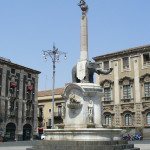
Elephant’s fountain
The Elephant’s fountain or even “Liotru’s fountain” was built by Gianbattista Vaccarini in 1757. In the basement there are some carved cherubs and two bas-reliefs representing the city’s two rivers, the Simeto and the Amenano. For people of Catania it is ‘u Liotru’.

St. Agatha Abbey
Next to the Cathedral, overlooking Via Vittorio Emanuele there is the St. Aghata’s Abbey. The Abbey was completed in 1735 and some critics think that this building is the architect Vaccarini’s masterpiece. A jewel realized in Sicilian baroque style.
Visit the terraces of the Abbey to admire the city in a different way.
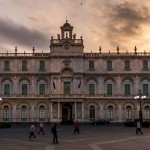
Palazzo dell’Università
The original Palazzo dell’Università’s plant is dated back to 1434. It was built by Alfonso the Magnanimous, founder of “Siculorum Gymnasium”. It was destroyed by the earthquakes in 1693 and in 1818; and restored many times over the centuries.
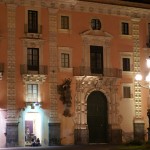
Palazzo Gioeni D’Angiò
Palazzo Gioeni D’Angiò was the residence of the Duke Giuseppe Gioeni D’Angiò, who commissioned its construction in the late eighteenth century. The design of this building, which is located in piazza Università, was conceived by the architect Vaccarini in Sicilian baroque style.
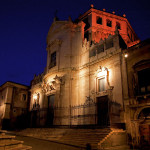
Saint Giuliano’s Church
It’s located in the charming and characteristic via Crociferi, it’s seen by many as the “pearl” of the eighteenth century city’s reconstruction. Although this building is attributed to Vaccarini’skill and was probably built between 1739 and 1751.

St. Benedict’s Church
It’s located at the beginning of via Crociferi, the Saint Benedict’s Church is an example of late baroque architecture in Catania. It was rebuilt immediately after the earthquake in 1693 with the S. Benedict’s arch, that was erected in 1704.
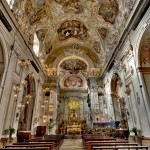
Historical Site Monastero San Benedetto
The Monastery of Saint Benedict, situated in via Crociferi – considered part of the human heritage of UNESCO – is one of the artistic symbols of Catania. It is commonly identifiable by the eighteenth century arch which spreads over the street and unites the Monastery’s main …
A cultural tour that is the result of an extraordinary combination of history, art and modernity.

Benedictine Monastery
It’s a “jewel” of the late Sicilian Baroque architecture and an example of integration among different periods, it is shown in UNESCO’s World Heritage Site. From 1977, the plezus monastic houses the Humanities faculty.